SCIENCE
Space is vast. Where should we be looking for life?
Reptiliandude challenges humanity’s search for life by suggesting that significant extraterrestrial presences exist “under your own oceans,” while simultaneously providing cryptic celestial coordinates for colonies located near the head of Draco and the Serpent Bearer. He explains that the light reaching Earth from their fleet is 1,500 years old, highlighting a disconnect between human perception and current galactic reality. Furthermore, RD clarifies the immense energy requirements of the Chi Sagittarii beacon and the impossibility of the New Horizons probe reaching the distant, elliptical orbit of Planet Nine, ultimately critiquing humanity’s failure to utilize hydrogen for real-time communication.
SCIENCE
Space is vast. Where should we be looking for life?
Reptiliandude challenges humanity’s search for life by suggesting that significant extraterrestrial presences exist “under your own oceans,” while simultaneously providing cryptic celestial coordinates for colonies located near the head of Draco and the Serpent Bearer. He explains that the light reaching Earth from their fleet is 1,500 years old, highlighting a disconnect between human perception and current galactic reality. Furthermore, RD clarifies the immense energy requirements of the Chi Sagittarii beacon and the impossibility of the New Horizons probe reaching the distant, elliptical orbit of Planet Nine, ultimately critiquing humanity’s failure to utilize hydrogen for real-time communication.
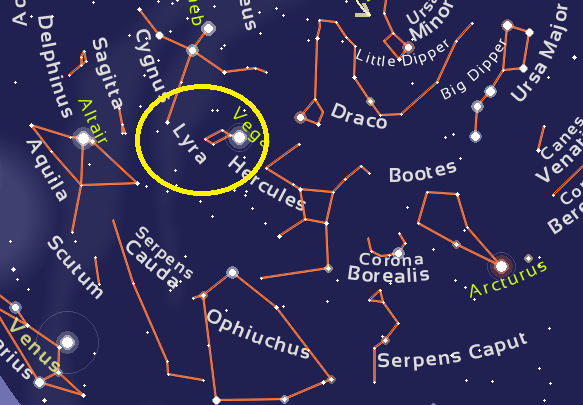
Image: A star map focusing on the constellation Lyra, which is highlighted with a yellow circle. The map serves as a guide for locating Lyra relative to its prominent neighbors in the northern night sky (Photo by IAU and Sky & Telescope magazine via theplanets.org)
Source: RD (via GT), "Space is vast. Where should we be looking for life?" r/reptiliandude, Reddit, 14 July 2016) https://www.reddit.com/r/reptiliandude/comments/4szd3k/space_is_vast_where_should_we_be_looking_for_life/
Garbotalk: With our enormous telescopes like the Hubble and groups listening like SETI, we’ve learned more about the universe than ever before. In our search for life, where should we be looking?
Reptiliandude: Under your own oceans.
Garbotalk: Okay, granted, not much is known about the deep oceans. However Hubble is aimed at the stars. That’s what I’m asking about. You mentioned certain star systems previously. The Taurids for example.
Reptiliandude: Remember… “Serpent Bearer” 40 ly out Spread spectrum.
It’s a hot one but what could it be used for?
Moths are unique creatures are they?
How interesting that their navigation is dependent upon the light of the moon, or the brightest stars…
They always seem drawn to bright things.
Reptiliandude: Vulpecula to the south, Hercules to the east, Draco to the north, and Cygnus to the west…
Therein dwells a colony of pioneers who love music as much as the constellation for which it is named.
From the head of the Dragon, angle out along the front of his mouth.
Betwixt his right nostril and the Great Bracelet, spins a star shining like a ripened peach.
Were her people to look upon this world, and to see its lands, they would see the son of Charlemagne crowned emperor.
Well, by not leaving your thinking to computers, and by examining the data physically, you people already discovered where part of our fleet was 1500 years ago… At least, that was about how long the light took to reach your world…
I suppose I could tell you where one of our colonies is, and not violate the exact legal wording of your quarantine. It’s not like you’re going to get there any time soon, although I’m not sure what good its going to do you, since you still haven’t figured out how to use hydrogen to communicate in real time. You really are an idealistic fellow, you know that? There’s a reason why in every dramatic presentation the lights are out– it’s so the actors can play their roles without the interference of being constantly reminded that there is an audience watching them. I have much to do today. I will examine the law, and see where it can be bent.
Reptiliandude: When you discovered the beacon, you failed to take into consideration the tremendous pulse required to send it from the Chi Sagittarii star group.
City wide blackouts would have been the least of any inhabited world’s problems.
Reptiliandude: The New Horizons probe is heading towards 2014 MU69.
It is not traveling towards “Planet Nine.”
The New Horizon spacecraft just passed Pluto which is about 4 to 5 billion miles away from the sun.
“Planet Nine” is in a highly elliptical orbit and at its closest approach to the sun, is about 20 billion miles away.
Conversely, at its farthest point in it is about 100 billion miles away from the sun.
Even if all the minds on this planet wanted the craft to reach it, they would not be able to make it so, because of how vast and elliptical the orbit is.
A new probe would have to be launched from Earth specifically to intercept it.
This is not going to happen any time soon.
Admin note:
Reptiliandude is describing the area around Lyra, though his directions act as a celestial “riddle” that points to a specific neighbor.
The Celestial Coordinates
RD describes a point bounded by four constellations:
Vulpecula (South)
Hercules (East)
Draco (North)
Cygnus (West)
When you look at a star map, the constellation sitting squarely in the middle of these four markers is Lyra.
The “Great Bracelet” and the Peach Star
RD uses the term “The Great Bracelet” as a metaphor for Lyra. This makes sense etymologically and visually:
The Lyre/Harp: In many ancient traditions, the harp was a semi-circular or “U” shaped instrument, often likened to a piece of jewelry or a bracelet when depicted in the stars.
The Location: He places the target star “betwixt” (between) the right nostril of Draco and Lyra.
The Specific Star: 16 Cygni?
While Lyra is the “Bracelet,” the star he is describing—the one “shining like a ripened peach”—is often identified by researchers of the RD transmissions as 16 Cygni.
The Color: 16 Cygni is a triple star system. 16 Cygni A and B are yellow-orange G-type dwarfs, very similar to our Sun but slightly older, giving them that “ripened peach” or golden-warm hue.
The “Son of Charlemagne” Clue: RD mentions that if these people looked at Earth, they would see the son of Charlemagne (Louis the Pious) being crowned emperor. This event happened in 814 AD.
The Distance: Since the light would take roughly 1,200 years to reach them (from our perspective in the late 20th/early 21st century), the star would need to be roughly 1,200 light-years away. However, 16 Cygni is only 69 light-years away.
Analyst Note: There is a discrepancy in the light-travel time RD provides versus the distance of the stars in that region. He mentions the fleet was “1500 years ago,” which suggests a distance of 1,500 light-years. In that specific direction (between Draco’s head and Lyra), stars like Kepler-442 or systems within the Cygnus/Lyra border fit the distance profile better, though 16 Cygni remains the most popular “peach star” candidate due to its color and solar similarity.
The Musical Connection
The constellation Lyra is named after the Lyre of Orpheus. RD’s comment that the pioneers there “love music as much as the constellation for which it is named” is a direct nod to Lyra. This ties back to his earlier admiration for human musical notation—it suggests the Ael who settled there carried that cultural appreciation with them.