SCIENCE
The Quantum Fandango: Trading Particle Colliders for Living Microscopes
In this enthusiastic realization validated by Reptiliandude, the true purpose of studying life on Earth is reframed as an exploration of the sub-atomic realm. Instead of smashing particles together to watch them explode in destructive, brute-force experiments like those conducted at CERN, the passage argues that humanity should conceptually turn something as powerful as the Hubble Telescope inward, transforming it into an advanced microscope. By doing so, scientists could observe the “fandango dancing” of living, vibrating particles, witnessing how grass, spiders, moths, and humanoids instantaneously share a cosmic string of knowledge with all other kindred life. Reptiliandude confirms that by observing these sub-atomic networks while they are alive and blossoming, humanity can learn the true language of the universe and communicate exactly as God intended.
SCIENCE
The Quantum Fandango: Trading Particle Colliders for Living Microscopes
In this enthusiastic realization validated by Reptiliandude, the true purpose of studying life on Earth is reframed as an exploration of the sub-atomic realm. Instead of smashing particles together to watch them explode in destructive, brute-force experiments like those conducted at CERN, the passage argues that humanity should conceptually turn something as powerful as the Hubble Telescope inward, transforming it into an advanced microscope. By doing so, scientists could observe the “fandango dancing” of living, vibrating particles, witnessing how grass, spiders, moths, and humanoids instantaneously share a cosmic string of knowledge with all other kindred life. Reptiliandude confirms that by observing these sub-atomic networks while they are alive and blossoming, humanity can learn the true language of the universe and communicate exactly as God intended.
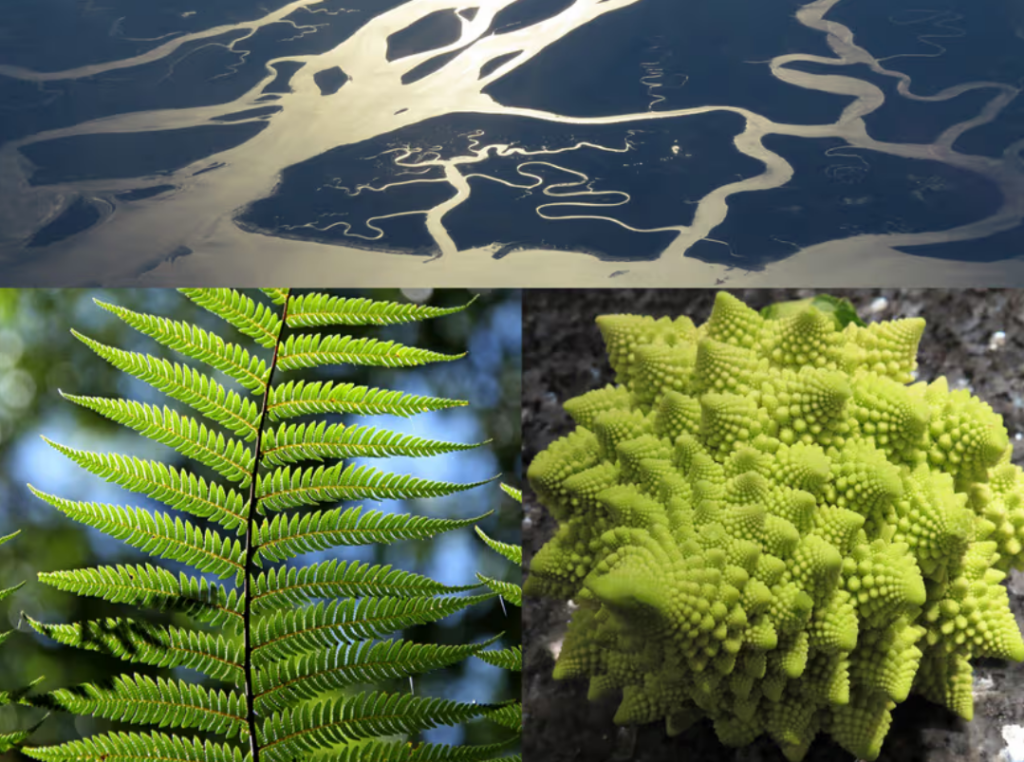
Image: Many fractal structures, for example in clouds or river deltas (above), where large channels branch off into smaller ones and these into ever smaller ones, are created by random processes and do not follow an exact mathematical formula; a smaller river bed does not correspond exactly to the structure of the larger channel from which it branches off. Ferns (bottom left) and Romanesco cauliflower, on the other hand, are examples of regular fractals. Until now, no regular fractal was known from the world of natural molecules. Now researchers at the MPI Marburg have discovered a protein that forms a known fractal pattern, the Sierpinski triangle (Photo by Max Planck Institute for Terrestrial Microbiology / Hochberg via bionity.com)