RELIGION
Just posting these here before incredulous mods delete them.
Reptiliandude explores connections between the story of Jesus and earlier solar myths, particularly the Egyptian story of Osiris, before turning to ancient Egypt and the reign of Piankhi, the Kushite ruler who he portrays as a reformer who restored traditional religious and political order. He contrasts Piankhi’s approach to leadership with what he sees as the restrictive influence of legislative monotheism in Judaism and Islam, describing the latter as shaped by an enduring conflict over religious inheritance between the descendants of Isaac and Ishmael. RD argues that more austere theocratic societies can limit artistic expression and social progress, while belief systems that embrace a wider spiritual universe may encourage broader understanding. He presents Piankhi as a ruler who did not simply impose the religion of a conquered people, but saw himself as an instrument of their gods, seeking to unite a divided nation through shared traditions and religious consistency.
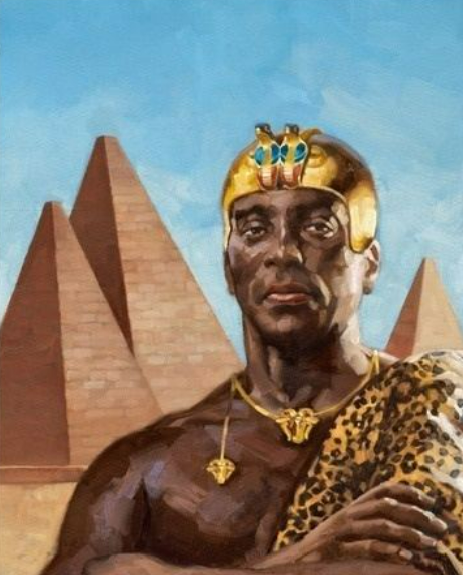
Image: African renaissance king piye and the empire of kush (Photo by Unkown Artist via Alchetron)
Source: RD, "Just posting these here before incredulous mods delete them." r/InsurrectionEarth, Reddit, (22 July 2018) https://www.reddit.com/r/InsurrectionEarth/s/HficJTJuuR
reptiliandude:
You’re welcome. Never did care much about winning popularity contests. It’s better to speak the truth and be despised by fools than to lie and be hailed as a wise one among them.
Understand that the concept of Jesus (birth and resurrection) flows with the solar myths such as (Osiris/Egypt).
Egyptian society, especially during the time of Piankhi was far from lily white.
The Hittites and the Hurrians were the ‘white people.’
As for Piankhi, much could be said about that ‘dark prince’ from Kush who invaded and reestablished Egypt’s social order in a ‘Holy War’ against corruption.
It was said among them that Piankhi was “More Egyptian than the Egyptians.” Primarily because he reinstated the role of Pharaoh as high priest and performed the ceremonies himself as did the ancient leaders before him.
You really should read up on him.
As for Islam: Islam is locked in step with legislative monotheism and Judaism.
It’s the religion of two brothers descendant’s fighting constantly over the right of inheritance (Isaac and Ishmael/ Israel and the entire Arab/Islamic world).
Not to say that both hadn’t a large part of their origins in Judaism.
It’s just that one is bound to the family feud and disallows the influence of paganism and depictions of living form in art.
And, having seen the effects of the Renaissance…
Well…
I think you get what I’m saying, and why social progress is absent in the more austere versions of those theocratic fiefdoms masquerading as republics for the sake of trade.
So be careful about rejecting a faith which puts one more in common with the people of a ‘greater universe’ than the squabbles and politics of local Semitic tribes.
Moreover… This most accomplished of all African kings, did not dwell upon the religion of his conquerors as an imposition forced upon his ancestors. Rather, he viewed himself as the vessel of those gods to bring consistency and common understanding to a nation consumed by its own disloyalty and vices.
Just some food for thought.