THE BEACON
Interstellar Misconceptions: Why New Horizons Cannot Reach Planet Nine
In this astronomical reality check, Reptiliandude dispels the online misconception that NASA’s New Horizons probe is on a trajectory to intercept the theoretical “Planet Nine.” He clarifies that the spacecraft’s actual destination following its Pluto flyby is the Kuiper Belt Object 2014 MU69 (known formally as Arrokoth), which resides roughly 4 to 5 billion miles from the Sun. By contrast, the hypothetical Planet Nine follows a massive, highly elliptical orbit that sits at a staggering 20 billion miles away at its closest approach (perihelion) and up to 100 billion miles away at its farthest point (aphelion). The narrator explains that no amount of collective human willpower could redirect New Horizons to bridge this vast directional and physical gap; tracking down Planet Nine would require engineering and launching an entirely new, dedicated interceptor probe from Earth—a feat that remains far out of reach for contemporary human aerospace logistics.
THE BEACON
Interstellar Misconceptions: Why New Horizons Cannot Reach Planet Nine
In this astronomical reality check, Reptiliandude dispels the online misconception that NASA’s New Horizons probe is on a trajectory to intercept the theoretical “Planet Nine.” He clarifies that the spacecraft’s actual destination following its Pluto flyby is the Kuiper Belt Object 2014 MU69 (known formally as Arrokoth), which resides roughly 4 to 5 billion miles from the Sun. By contrast, the hypothetical Planet Nine follows a massive, highly elliptical orbit that sits at a staggering 20 billion miles away at its closest approach (perihelion) and up to 100 billion miles away at its farthest point (aphelion). The narrator explains that no amount of collective human willpower could redirect New Horizons to bridge this vast directional and physical gap; tracking down Planet Nine would require engineering and launching an entirely new, dedicated interceptor probe from Earth—a feat that remains far out of reach for contemporary human aerospace logistics.
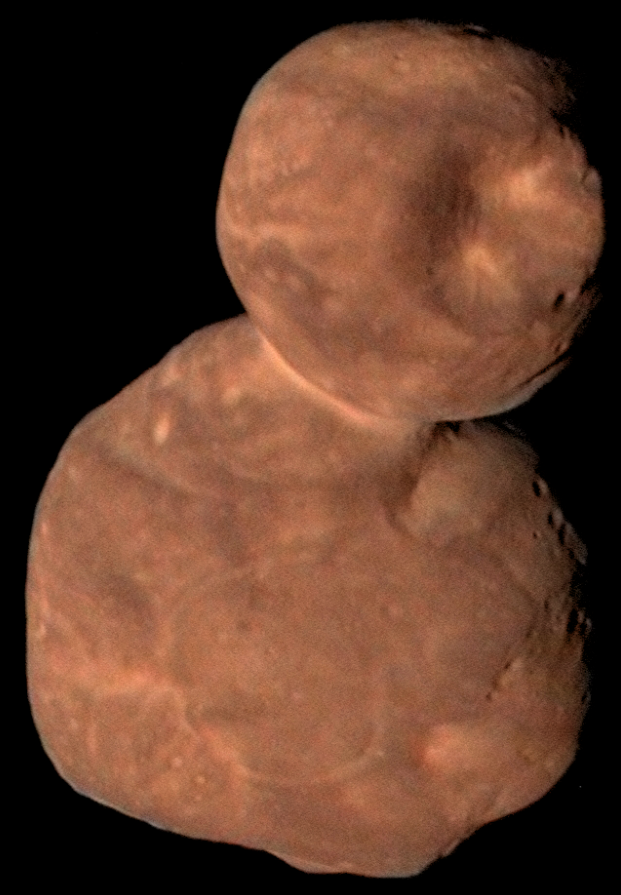
Image: This composite image of the primordial contact binary Kuiper Belt Object 2014 MU69 (nicknamed Ultima Thule) – featured on the cover of the May 17 issue of the journal Science – was compiled from data obtained by NASA’s New Horizons spacecraft as it flew by the object on Jan. 1, 2019. The image combines enhanced color data (close to what the human eye would see) with detailed high-resolution panchromatic pictures (Photo by NASA/Johns Hopkins University Applied Physics Laboratory/Southwest Research Institute/Roman Tkachenko via Wikimedia Commons)
Source: RD (via GT), "Space is vast. Where should we be looking for life?" r/reptiliandude, Reddit, (2016, July 14) https://reddit.com/r/reptiliandude/comments/4szd3k/space_is_vast_where_should_we_be_looking_for_life/
Reptiliandude: The New Horizons probe is heading towards 2014 MU69.
It is not traveling towards “Planet Nine.”
The New Horizon spacecraft just passed Pluto which is about 4 to 5 billion miles away from the sun.
“Planet Nine” is in a highly elliptical orbit and at its closest approach to the sun, is about 20 billion miles away.
Conversely, at its farthest point in it is about 100 billion miles away from the sun.
Even if all the minds on this planet wanted the craft to reach it, they would not be able to make it so, because of how vast and elliptical the orbit is.
A new probe would have to be launched from Earth specifically to intercept it.
This is not going to happen any time soon.