THE BEACON
The Flickering Candle: Pulse-Based Logic and the C60 Cage
In this highly technical conclusion, etwaskatze and GT hypothesize that quantum entanglement can be achieved by encapsulating hydrogen isotopes within C60 (Fullerene) spheres, creating a “flickering candle” capable of transmitting data. RD guides them away from “unwieldy” Morse code toward a pulse-based TapCode system, suggesting that humanity should first communicate using a “Rosetta Stone” of simple mathematical functions. While RD maintains a “no comment” stance on specific engineering to avoid breaking his “quarantine,” he drops heavy hints about Russian Nixie tubes, proton weights, and carbon filaments. The exchange ends on a haunting note as RD feigns distraction with his own fusion plasma beam, while noticing a cup vibrating in his “reception” area—implying the users’ theoretical work may already be affecting his physical reality.
THE BEACON
The Flickering Candle: Pulse-Based Logic and the C60 Cage
In this highly technical conclusion, etwaskatze and GT hypothesize that quantum entanglement can be achieved by encapsulating hydrogen isotopes within C60 (Fullerene) spheres, creating a “flickering candle” capable of transmitting data. RD guides them away from “unwieldy” Morse code toward a pulse-based TapCode system, suggesting that humanity should first communicate using a “Rosetta Stone” of simple mathematical functions. While RD maintains a “no comment” stance on specific engineering to avoid breaking his “quarantine,” he drops heavy hints about Russian Nixie tubes, proton weights, and carbon filaments. The exchange ends on a haunting note as RD feigns distraction with his own fusion plasma beam, while noticing a cup vibrating in his “reception” area—implying the users’ theoretical work may already be affecting his physical reality.
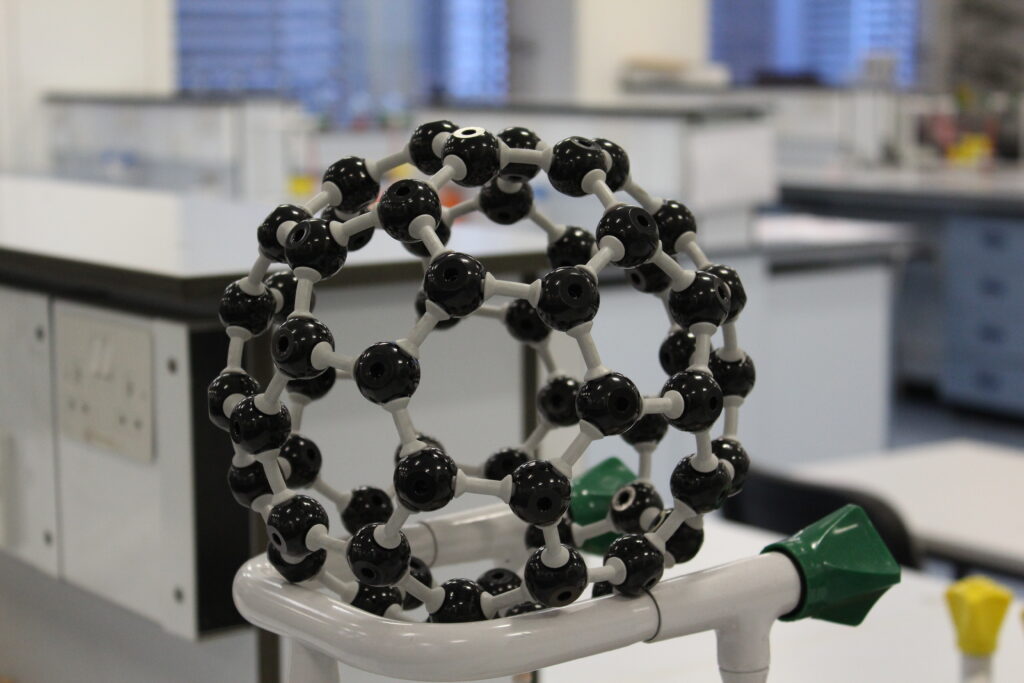
Image: This model shows the arrangement of carbon atoms in a fullerene (or ‘buckyball’) a large molecule made up of 60 carbon atoms. (Photo by UCL Chemistry via Wikimedia Commons)
Source: RD, "All about the Beacon " r/InsurrectionEarth, Reddit, (September 10, 2018) https://www.reddit.com/r/InsurrectionEarth/comments/9ehyzf/all_about_the_beacon/
etwaskatze: Was wondering about RD’s references to hydrogen and using base twelve systems. It got me thinking about carbon 12 and the very interesting allotropes it forms, specifically Carbon 60 that forms into a sphere using pentagonal structure, the pentagon itself being a physical repreentation of the golden ratio and the fibonacci sequence.
Was wondering if hydrogen gas encapsulated in C60 sphere and the excited with an electrical current could somehow be related to the “flickering candle” he keeps mentioning.
Reptiliandude: No comment.
Garbotalk: Although “no comment,” seems dismissive, it is not. Usually when I suggest something that is right on the money or close, a “no comment” from him is RD not breaking quarantine, because specifically confirming the truth of what I suggested is not allowed. Thus, if understood, our currency remains our own.
I believe you are headed in the right direction if not on the nose.
Reptiliandude: shifts in chair… smiles
etwaskatze: Ok. So hydrogen emits different wavelengths and frequencies as it goes back to its ground state depending on which level it is excited to. Combining these states and wavelengths, it would be possible to come up with an alphabet similiar to morse code to send messages to receptors calibrated to pick up those wavelengths, but those wavelengths would not travel faster than the speed of light, unless there was a quantumly entangled hydrogen molecule recieving the information.
This is not something that just happens. It might be possible with CERN, but the experiments they have conducted involved them specifically preparing the particles in question. I.e. building both sides of the walkie talkie at the same time and they only talk to each other. I don’t know how you could force quantum entanglement from so far away.
Reptiliandude: Not Morse Code.
Morse Code is unwieldy because of the long dashes.
Rather, the species can perform its baby steps via the TapCode used by POW’s in Vietnam.
Also, we are not talking about ‘wavelengths.’
Before you shoot yourself in the foot pontificating about what cannot be done, I strongly suggest that you examine various methods of what CAN be done..
http://mobile.nytimes.com/1997/07/22/science/far-apart-2-particles-respond-faster-than-light.html I cannot hold your hand and walk you through this.
You must abandon the hopelessness and purposelessness that has been intentionally cultivated in you to keep you from moving in this direction. You must learn to speak in real time. Preferably, before ‘your own’ financial institutions chip you like cattle.
Garbotalk: This is vital information and should be shared among all those seeking to answer the beacon. The first steps have been taken, then repressed and misdirected away from our continued pursuit. We must act on this as soon as absolutely possible! etwaskatze: Ok. Totally not giving up. Not giving that impression. Morse code or tap code (with base 5 and going to 25 omitting the letter c) is up to the linguists, not me. What I am concerned with is the quantum entanglement. Does a C60 cage around hydrogen make a quantum entanglement automatically?
Reptiliandude: No comment.
stirs nuclear ‘chicken soup.’
etwaskatze: Ok. The POW tap code had a base of 5 with the letter C omitted… 5 different levels that hydrogen can be excited to. Tap the row then the column, got it but is the indo european alphabet really universal?
Reptiliandude: No.
It is not.
You are missing the point.
The point which I am making is that it is a ‘pulse-based’ way of communicating with all of the ‘pulses’ being of the same duration and length. You cannot at this time determine which spin characteristics would result.
But the moment that they occurred could be understood in terms of rows and columns if ‘timed’ correctly. And, of course the corresponding particles would ‘echo’ that ‘sentiment.’ Think of it yourselves as creating a ‘Rosetta Stone’ of an important mathematical principle before you try and speak with any other form of a developed language.
etwaskatze: So, the tap code was very specific to the english alphabet. I don’t see how we could use it to another language.
But the pow tap code was based upon the english alphabet, i.e. 1:1 was “a” 1:2 was “b” 2:1 was “f” and 3:1 was “k.” We do not have another alphabet that fits into this sequence (asianic, cyrillic or arabic). Is there a new alphabet that we need to discover?
Garbotalk: Using our own alphabet will suffice to get the ball rolling. Focusing on the message is less important than the method to send it. The Fibonacci sequence or pi would be a powerful message, numeric, and understood by all.
Reptiliandude: Are you telling me that you’ve never used columnar math functions?
Get yourself a Newton’s Cradle and ponder the possibilities.
Here: I’ll help you. . . .. .. .. ….
Not sure about you, but if I saw my ‘lamp’ ‘flickering’ to one plus one makes two and two plus two males four, I’d conclude that there was intelligent life tapping on its baby crib. You’re biting off a lot to chew at once. How about ‘Chopsticks’ beginner skillz before playing a Fibonacci concerto?
etwaskatze: I wonder if the number of hydrogen molecules enclosed within the sphere make a difference…
Reptiliandude: I’d be more concerned about the ‘weight’ and number of protons if I was working with ‘hydrogen.’
etwaskatze: Kind of one and the same with hydrogen unless you sre talking deutrium or tridium…
Deutrium and tridium do not have the same quantum characteristics as Hydrogen and tridium is not naturally occring, and deutrium is less than 1% of naturally occuring hydrogen and would not have been included in the spectrum that the “wow” signal sent.
Reptiliandude: Nope.
Glad we are on the same page. But they can be used to add some ‘umph’ to the ‘record needle.’
etwaskatze: So, are we talking purely using one isotope, or mixing them? The “heavier” isotopes would have a harder time making it out of the nano structure, but exciting them would make rupturing the carbon sphere easier, making what would most likely be a really long chain radioactive hydro carbon instead of a cosmic crystal ball. Although this does bring up some very interesting options for hazardous waste storage and disposal…hmmmm
Reptiliandude: Have you ever seen Russian Nixie Tubes?
http://rutubes.com/category/nixie-tubes/
I think it’s delightfully ‘retro’ how a ‘tube’ can represent numbers and symbols.
Of course, they take a lot of energy because of the type of ‘filament.’ But they have a really nice look, don’t they?
Especially, when built into clocks . https://www.nuvitron.com/
All those cathodes all ‘strung’ together. Phosphor, high pressure gasses and photons all working together.
We should have a carbon day, to celebrate the minx that made all this possible.
Garbotalk: There are patent applications for using a fullerene encapsulation of hydrogen isotopes for nuclear fusion that would be worth reviewing.
Everyone should google “nano encapsulation of hydrogen molecules in fullerene C60.”
http://www.sciencedirect.com/science/article/pii/S0141391002000873
Perhaps some others may pick up some good nuggets from this.
etwaskatze: Sooo…not a vacuum tube or semi-conductor, something more like a gas filled tube we’ll say H2 for fun, that perhaps has a carbon nano tube for a filament that excites a Buckeyball filled with tritium, which oscilates like a quartz clock and can calibrate frequencies from similiarly configured hardware?
Reptiliandude: Huh?
Sorry…
I can’t hear you over this plasma beam I’m trying to keep steady.
F’n fusion…
So hard to sustain, you know?
Not sure what you’re working on, though.
*Glances at ‘security camera’ and sees ‘cup’ ‘vibrating’ on the coffee table in ‘reception.’
Huh…
That’s weird.
Admin note:
CERN (the European Organization for Nuclear Research) investigates various allotropes of carbon-12 (the stable, most abundant isotope of carbon) for applications in high-power particle accelerators and detectors, focusing on their thermal, mechanical, and electron-emission properties. The research at CERN aims to combine the benefits of different carbon forms, such as graphite and diamond, with metals to create robust materials capable of withstanding the extreme environments of collider beams.
Key Carbon Allotropes Studied at CERN
- Graphite & Graphite Composites: Used in beam dumping systems (like at the Large Hadron Collider) due to its high thermal stability and conductivity.
- Diamond & Diamond-Like Carbon (DLC): Studied for its high thermal conductivity and low electron emission properties.
- Nanocrystalline Graphite/Amorphous Carbon: Coated on surfaces to reduce secondary electron emission (SEY) to stabilize accelerators like the Super Proton Synchrotron.
- Fullerenes (C60): Investigated in proposals for antimatter containment research (e.g., placing antiprotons inside “buckyballs”) at the ELENA facility.
Carbon Fibers/Composites: Used to reinforce materials like Molybdenum Carbide-Graphite (MoGr) to improve mechanical strength and thermal properties.
Research Objectives and Applications
- Low Secondary Electron Emission (SEY): Research focuses on coatings that reduce electron-cloud effects in particle beams, which can destabilize accelerator performance.
- Irradiation Targets (ISOL): Carbon materials are used as target materials for producing radioisotopes, requiring high porosity, high-temperature resistance, and good thermal conductivity.
- Novel Materials: Development of hybrids like Copper-Diamond (CuCD) or Molybdenum-Diamond (MoCD) for high-performance beam intercepting devices.
Nuclear Structure Research
Separate from the macroscopic material research, CERN researchers have also participated in the study of the Hoyle state of the carbon-12 nucleus. This research uses nuclear lattice effective field theory to understand how the nucleus of carbon-12 is formed from three alpha particles (helium-4 nuclei) arranged in an equilateral or obtuse triangular shape.